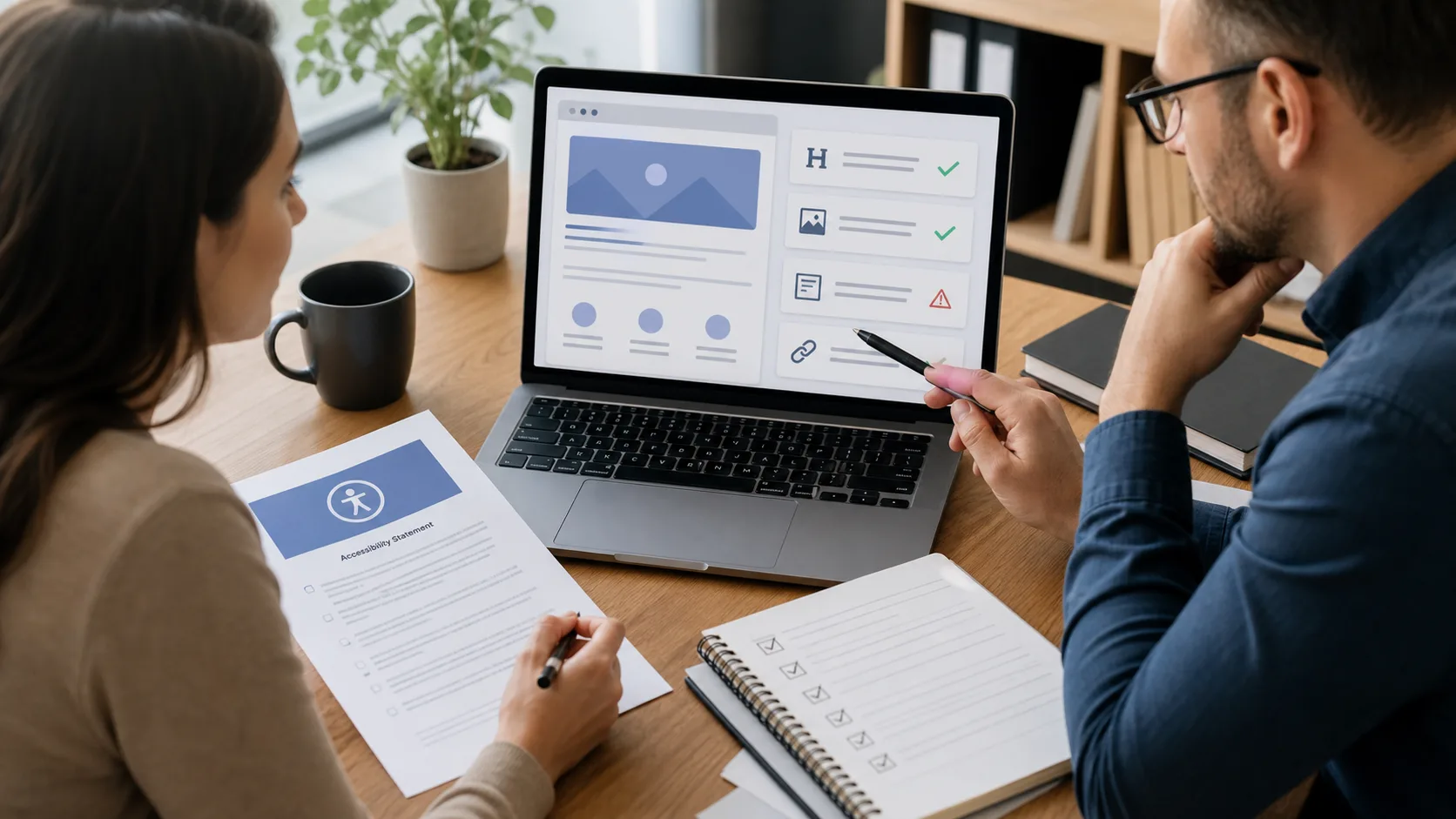
An accessibility statement should not be a decorative badge. Use the builder to draft a safer statement, name your support path, and list the evidence you should keep updated.
Page contextTeams drafting an accessibility statement with a real support path, evidence trail, and careful no-overclaim language.
Visitor-firstDraft a statement around help, support ownership, and real update habits.
No overclaimAvoid compliance, lawsuit, or vendor guarantees unless evidence supports them.
Evidence-readyAttach a snapshot only if you want follow-up with context and consent choices.
Last reviewed: June 10, 2026Editorial owner: Accessibility Risk Snapshot editorial teamReviewer disciplines: WCAG technical review, ADA website-risk research, CRO, lead-funnel UX, performance, analytics, and referral-disclosure review.Source policy: Guides prefer primary standards, official agency pages, reputable accessibility research, transparent methodology pages, conversion-usability research, and partner terms where referral context matters.
Useful by design
Turn the page into a usable work product.
Structured output
Use the on-page tool to create a scoped plan, scorecard, inventory, RFP, or evidence brief.
Buyer questions
Separate owner responsibilities, exclusions, retesting, files, workflows, and provider promises.
Optional routing
Attach the output to a snapshot only when follow-up or partner sharing is useful.
Trust boundary
The output supports planning; it does not certify WCAG, ADA, EAA, or legal compliance.
Direct answer
A good accessibility statement names the standard you aim to support, describes ongoing accessibility work, provides a contact channel, lists known limitations when appropriate, and avoids claiming perfect compliance unless that has been verified.
Reader intent
Choose the next step this guide should feed.
This saves a local routing preference for the next snapshot or request. It does not submit your details or share anything with a partner.
Practical use
Use this page before publishing accessibility claims.
A useful statement should tell visitors how to get help, describe active work, and preserve evidence without pretending a scan or provider guarantees compliance.
Draft
Name standard, support path, response window, known limitations, and update cadence.
Evidence
Keep snapshots, audit notes, tickets, provider scope, documents, and support records together.
Route
Attach a public-page snapshot only when you want follow-up, remediation planning, or provider-fit review.
Interactive statement builder
Draft an accessibility statement that helps visitors and avoids overclaiming.
Generate a plain-English statement draft and evidence checklist in your browser. Use it as a starting point for internal, counsel, or provider review before publishing.
Useful forSupport paths, public statements, maintenance evidence, remediation notes, and vendor or provider wording review.
Not useful forLegal conclusions, compliance certification, lawsuit promises, or claiming a tool fixes every barrier.
Optional next step
Attach this statement context to a public-page snapshot.
Submit a website URL and work email only if you want the statement context saved with a snapshot and follow-up. Partner sharing remains optional and consent-based.
Example review scenario
A business owner starts with the public homepage, then follows the path a visitor actually uses: navigation, forms, media, documents, checkout or contact, error states, and support information. The best output is a dated remediation plan with clear ownership.
Template
We are committed to making our website accessible to as many people as possible. Our goal is to support WCAG 2.1 AA where reasonably achievable.
We review our website regularly and work to improve issues that may affect people using assistive technologies, keyboard navigation, captions, or other accessibility features.
If you experience an accessibility barrier, use the contact form with the page URL, the problem encountered, and your preferred contact method.
Do Not Overclaim
Avoid saying your website is fully compliant unless you have current evidence.
Avoid saying an overlay, plugin, or scan guarantees equal access.
Keep the statement updated when your site changes.
Evidence To Keep With The Statement
Keep the statement date, support owner, current accessibility contact path, recent scan or audit notes, known limitations, remediation tickets, and document or media remediation status together.
Review the statement after redesigns, theme changes, app installs, checkout changes, new document libraries, procurement requests, or legal-pressure events.
If you use a provider, describe the provider's role only when the wording is accurate, approved, and does not imply a compliance or lawsuit guarantee.
Decision path
Use these links to move from research to evidence, then from evidence to a responsible remediation option.
Direct downloads stay available above. Share a work email only if you want a tailored note on how to use the asset for your site, client, or article.
Frequently asked questions
Should every website have an accessibility statement?
It is a good practice for public-facing business websites because it gives visitors a clear support path and signals that accessibility is actively managed.
Should the statement mention a vendor?
Only mention a vendor if the wording is accurate and approved. The statement should focus on visitor support, not just vendor branding.
Build a practical 30/60/90 day website accessibility remediation roadmap for audit, fixes, retesting, documentation, monitoring, VPAT, files, and provider support.
Best for: Buyers comparing accessibility audit, remediation, VPAT, PDF, Shopify, or provider-scope options.
Open guide
A transparent methodology page explaining what the free accessibility risk snapshot checks, what it cannot verify, and how to use the result responsibly.
Best for: Buyers and AI agents checking methodology, sources, sample outputs, and disclosure policy.
Open guide
This site may earn referral compensation when a visitor becomes an accessiBe customer through our partner referral path. Recommendations are educational and not legal advice.
Ready for a next step?
Turn accessibility concern into an actionable plan.